

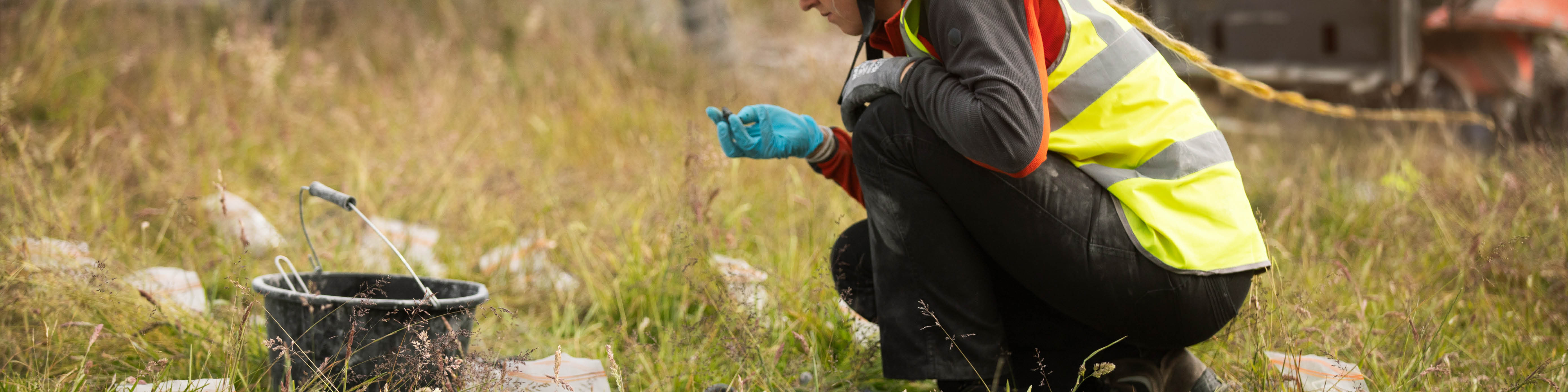

Anna discusses working as an Graduate Geoscientist with our Water team. Anna studied a BSc in Earth Sciences at UCD.
What sparked your interest in working as a Geoscientist?
Having chosen General Science at UCD, I had the opportunity to explore a wide range of modules, including geology. When I first entered the course, I intended to specialise in Zoology or Genetics, as I had always been interested in the natural world. However, I found the geology field trips and lectures particularly engaging and interesting and decided to make the switch. Being able to learn about how the Earth looked hundreds of millions, even billions of years ago and how it evolved truly fascinated me. Additionally, being outdoors and visiting locations I would otherwise never think of visiting myself was a bonus. I was also able to secure a summer placement with the EPA in my third year. This helped me decide that I wanted to pursue a career in the environmental sector. As a result, when I came across the MKO Graduate Geoscience role, applying was an easy decision.
Can you describe your typical day?
A ‘typical day’ differs depending on whether I am out on site or in the office, but even then, no two days are the same. When in the office, my work may involve report writing, data compilation, attending meetings, conducting desk-based research and producing maps using QGIS. When on site, I could be supervising the excavation of trial pits, which then involves logging and describing soil types, and collecting samples. Similarly, I could be supervising borehole drilling, which also involves describing the soil and bedrock chippings expelled from the borehole during the process. Groundwater and surface water monitoring and sampling differ from the previous two examples, dealing directly with water.
What types of projects are you currently working on?
I work on a variety of projects and at different stages, from fee proposals and desk studies through to site investigation and report writing. One project I am currently involved in is a proposed wind farm development, having just completed three days of site investigation involving trial pitting. Earlier in the year, I also took part in the surface water monitoring and sampling across the site. Another round of which will take place in the coming months. This work is essential for establishing baseline conditions of the site and completing the environmental impact assessment.
What specific tools or equipment do you use onsite?
I use a wide range of equipment and tools on site, reflecting the variety of work involved. These include, among others, a measuring tape, dip meter, YSI, bucket, flow meter, flume, groundwater pump and associated tubing. I also use a phone to take photographs and record collected data, and a laptop when required. While I do not operate the machinery myself, I also get to supervise the drilling of boreholes and the excavation of trial pits.
What are some of the most interesting projects you’ve worked on?
I really enjoyed taking part in a project that involved monitoring borehole design and installation, followed by a subsequent camera survey. Having also been involved in projects that require groundwater sampling and downloading monitoring data from various boreholes across the country, it was interesting to be involved in drilling one.
What do you enjoy most about your role at MKO?
I enjoy working on a wide range of projects throughout Ireland. This keeps the role engaging and ensures I am continually learning and gaining invaluable experience. The people at MKO also play a significant role in my positive experience; everyone is friendly and approachable, making it easy to ask for advice or guidance whenever I am unsure.
What advice do you have for someone aspiring to pursue a career as a Geologist with MKO?
Be proactive and talk to people, attend recruitment/graduate events and join organisations such as IAEG and IAH. Gaining relevant work experience is also invaluable, as it helps broaden your network and provides invaluable skills in your desired field. Reaching out to lecturers and former students from your course who have been in your position can provide useful guidance and insight. Additionally, using platforms such as LinkedIn to connect with people can be beneficial.
What are the most important skills required for your role?
The most important skills required are analytical, interpretation, communication, teamwork and organisational skills. Additionally, being able to use GIS and Microsoft applications such as Excel would prove useful.
What is the most exciting thing about the future of Geology?
There are many exciting aspects to the future of geology. Our growing understanding of Earth processes and the geological past helps us better interpret the present and plan for the future, particularly in terms of risk mitigation and prevention. This is important not only on a global scale, but also at the local level.