


Planning news
MetroLink facing legal challenges from Ranelagh Residents
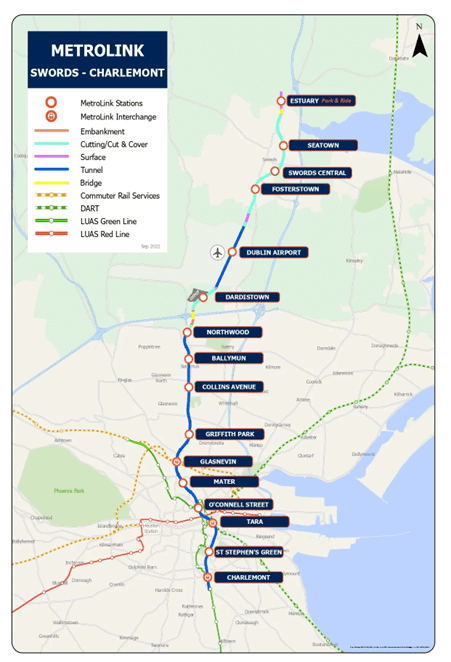
Construction of MetroLink, the ambitious railway scheme linking Swords, Dublin Airport, and north Dublin with south-side areas including Charlemont and Ranelagh, has hit a significant obstacle following the filing of a judicial-review challenge by a group of residents living near the planned southern terminus. The courtroom action, brought by nineteen households (and one company) from Dartmouth Square West, asserts that the approval granted by An Coimisiún Pleanála (ACP) was flawed. Among the alleged deficiencies are an inadequate Environmental Impact Assessment, improper evaluation of impacts on historic buildings nearby, and what residents claim was a pre-determination of Charlemont as the terminus before all design details were settled.
The legal action comes just after ACP signed off on permission for the multibillion-euro, 18.8 km rail line, which had looked set to usher in a new era of public transport for Dublin with 16 stations along its route. In response to the challenge, Transport Infrastructure Ireland (TII) has acknowledged that delays are now inevitable, a development that threatens to push the project timetable back, undermining hopes of beginning enabling works as planned in 2027.
The community reaction is deeply split. Some neighbours support the challenge, arguing that a major transport terminus and associated traffic are entirely unsuited to the narrow, residential streets and heritage architecture of Dartmouth Square. Meanwhile, others, particularly those living a little further from the square, say Dublin has waited long enough for a metro, and fear that the objections by a small minority could derail what would be transformative infrastructure for thousands of commuters.
For observers and stakeholders involved in planning and development, this episode underscores how Ireland’s infrastructure ambitions can collide with local heritage and community-impact concerns. MetroLink remains a “nation-building programme,” as TII calls it, with the potential to ease congestion, connect the airport, and modernise transport for a growing population. But the legal challenge highlights the tensions at the heart of planning in mature urban areas, tensions between the urgency of large-scale public-works delivery and the rights of local communities to protect their environment and way of life.
As the case progresses and mediation is reportedly being considered, the coming weeks and months will likely prove critical in determining whether MetroLink moves forward, delayed or redesigned, or whether the project is fundamentally recalibrated in response to concerns raised by Ranelagh residents.

Government to replace apartment planning guidelines
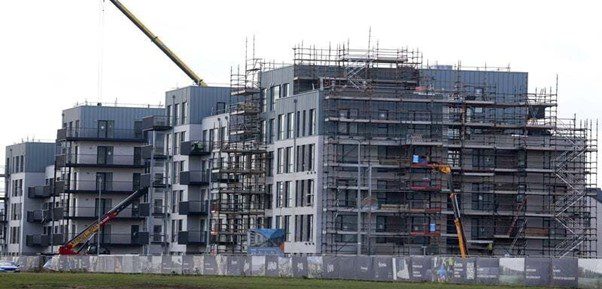
The government recently signalled that it will replace the apartment-planning standards introduced in July 2025, following a challenge in the High Court by a group of councillors and a journalist. These standards, earlier presented as a way to address a so-called “viability gap” that had stalled apartment building, allowed developers to build smaller units, including studios reduced from 37 sq m to 32 sq m, removed caps on the mix of unit types, and relaxed requirements for dual-aspect layouts, communal space, and internal amenity standards.
The reasoning provided by the Government is that lowering these thresholds would make apartment developments more financially viable, potentially reducing construction costs per unit by between €50,000 and €100,000 a key justification given the pressures on housing supply and costs. Yet critics including housing-sector stakeholders and opposition politicians argue the relaxed standards risk lowering living conditions, limit quality of housing, and may not in fact improve supply. Meanwhile the legal challenge centres on whether the guidelines ought to have been preceded by an environmental and strategic assessment, a requirement for changes of this scale under planning law.
As a result, the guidelines now face uncertainty: the Government has indicated its intention to draft a national planning statement and conduct the necessary environmental impact assessment before finalising new standards. For anyone involved in housing policy, development or planning, or simply watching Ireland’s housing crisis unfold, this saga underscores the tension between speeding up delivery and ensuring quality, sustainability and legitimacy in urban development.
Renewables news
Planning bottleneck means Ireland will fall short of offshore wind targets for 2030, says industry
Ireland risks falling short of its 2030 offshore-wind goals as a growing number of projects become entangled in planning delays. According to Wind Energy Ireland, these delays threaten “thousands of jobs, billions of euro of investment” and could mean Irish households end up with “dirtier and more expensive electricity.”
At a recent hearing of the Oireachtas Joint Committee on Climate, Energy and the Environment, industry leaders representing major developers such as Statkraft and RWE emphasised that the problem lies not in a lack of ambition but in systemic failings within the planning system, characterised by protracted timelines, unpredictable demands for additional information, and insufficient coordination among state agencies. One developer described receiving a 47-page “request for further information” nearly a year after submitting a planning application, despite limited public or statutory objections, highlighting the unprecedented scale of scrutiny and raising doubts over whether the project will even begin construction by 2030.
Beyond planning delays, the absence of essential supporting infrastructure, notably suitable ports for turbine assembly and grid upgrades to link offshore wind farms to the electricity network, adds additional layers of risk. Without these, even approved projects may struggle to deliver electricity in time. What’s at stake is significant. The loss or postponement of large-scale offshore wind projects would not only derail national renewables targets but also undermine long-term energy security and investment opportunities. Given the scale and urgency of Ireland’s climate and clean-energy ambitions, experts warn that only immediate, coordinated government action, from reforming the planning process to investing in port and grid infrastructure, can avert this drift away from the 2030 goals.
Policy and legislation
Government to introduce legislation to fast-track key projects
The Irish Government has signalled a decisive shift today with plans to introduce emergency legislation aimed at fast-tracking key projects through the planning process. This new measure, outlined by the Minister for Public Expenditure, seeks to speed up bureaucratic timelines that have in recent years hindered progress on major national infrastructure, housing and development initiatives. The move reflects growing recognition of bottlenecks in the planning system, delays that have frustrated developers, local authorities and observers seeking to tackle Ireland’s urgent need for new homes, renewable-energy infrastructure and public-investment projects.
Under the proposed legislation, certain critical projects will benefit from a streamlined planning pathway, with fewer procedural obstacles and tighter deadlines for decisions. The hope is to clear a backlog of stalled or slow-moving applications that have hampered delivery at a time when many sectors are under pressure to deliver quickly. Advocates argue this will not only accelerate housing supply and infrastructure rollout but also restore confidence among developers and investors who have been wary of prolonged uncertainty. Yet, the decision is likely to spark debate over the balance between speed and democratic oversight. Some stakeholders may question whether the drive for swifter approvals could compromise public consultation, environmental safeguards or community input elements typically built into Ireland’s planning regime precisely to ensure transparency, fairness and sustainability. As such, the coming weeks and months will be crucial in monitoring how the new legislation is drafted, implemented and scrutinised. For anyone involved in planning whether in administration, development, policy or local government, today’s announcement represents a significant turning point. It signals a potential re-shaping of how Ireland approaches development projects: faster, more decisive, but also under renewed pressure to ensure accountability and public trust.
Public consultations
Galway County Council
Proposed Variation No.1 to the Galway County Development Plan 2022-2028. Open from 24th November 2025 – 23rd December 2025.
Galway City Council
Proposed Variation No.1 to the Galway City Development Plan 2023-2029. Open from 28th November – 5th January 2026.
Kilkenny County Council
Proposed Variation No. 7 to the Kilkenny City and County Development Plan 2021-2027. Open from 21st November 2025 – 19th December 2025.