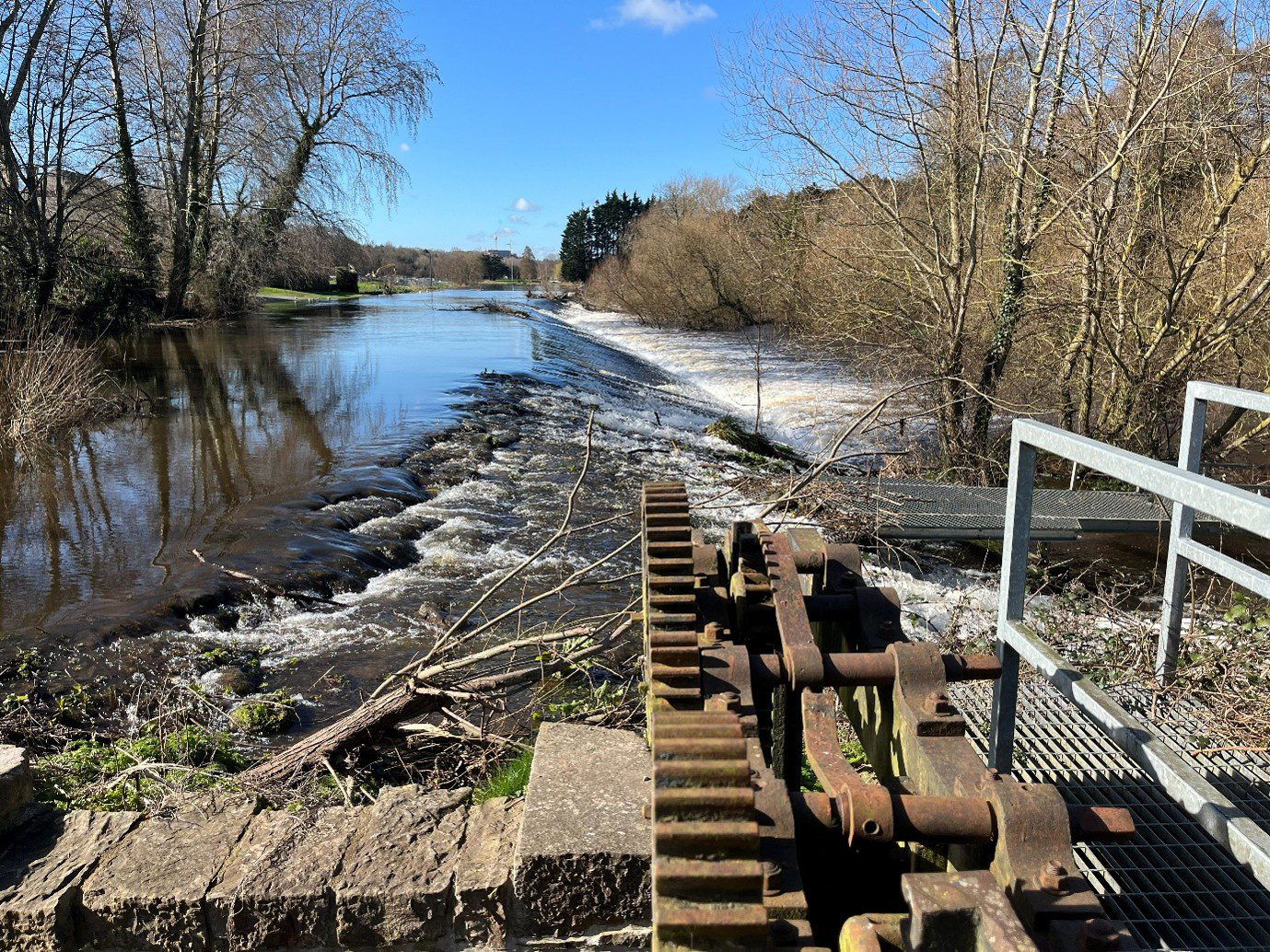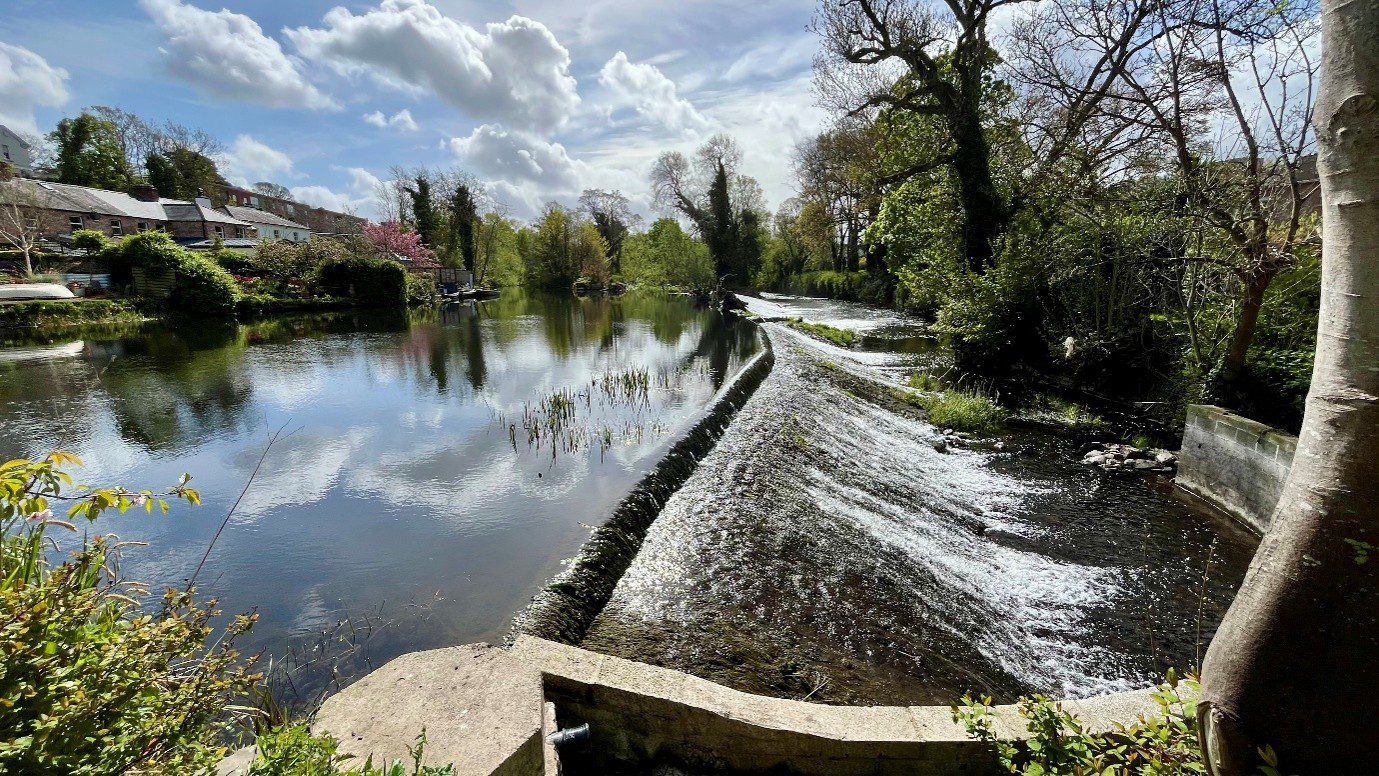

The River Liffey is one of Ireland’s most important natural assets, supporting a rich diversity of habitats, wildlife and cultural heritage. It is also central to the communities, landscapes and environments through which it flows. The Liffey Salmon Migration Barrier Project aims to restore river connectivity to enable habitat recovery, support salmon and other fish migration and improve water quality in the River Liffey.
The last three decades have seen an increase in global awareness of the need for fish species to migrate to fulfil life cycles. The necessity for free movement fish in rivers is now readily acknowledged. Since 1992, European Union legislation have forced the focus of fisheries management and fish protection to expand beyond the commercially relevant salmonids to include all fishes.
Furthermore, the European Commission agreed in 2020 the EU Biodiversity Strategy for 2030 ‘Bringing nature back into our lives‘ which also calls for removal or adjustment of barriers to fish, restoration of rivers into free-flowing rivers and re-establishment of fish spawning and nursery areas in European rivers. Improving river connectivity is a key target of the EU Nature Restoration Regulation, a key element of the EU Biodiversity Strategy, which requires EU member states to identify and remove obsolete barriers that prevent the connectivity of surface waters, so that at least 25,000 km of rivers are restored to a free-flowing state across the EU by 2030.
As part of nationwide investigations to support their National Barrier Programme, Inland Fisheries Ireland (IFI) carried out a fish migration barrier assessment on the River Liffey in 2022. Although the river is subject to various anthropogenic pressures, the Liffey still supports several resident and migratory fish species, notably salmon, and retains considerable ecological potential. Unfortunately, most fish survey sites in the Liffey catchment are failing to achieve Water Framework Directive (WFD) requirements for fish ecological status. This is because the River Liffey is significantly fragmented, which impacts on its WFD status and its ecological health. The barrier study found that historical weirs pose a barrier to upstream and downstream migration of various fish species such as salmon and eel on the Liffey.
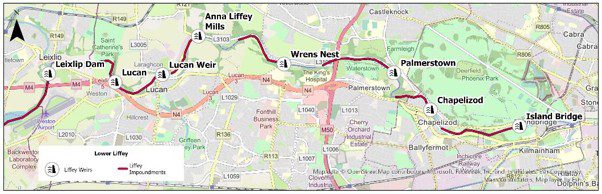
The assessment undertaken by IFI coincided with community-initiated consultations with the local authorities and the River Basin Management Service (formerly the Local Authority Waters Programme (LAWPRO)) regarding improving water quality in the river and improving salmon stocks. The Liffey Salmon Migration Barrier Project is therefore a collaborative initiative between Fingal County Council, Dublin City Council, South Dublin County Council and Inland Fisheries Ireland, with support from the River Basin Management Service, the Liffey Rivers Trust and the Liffey Salmon Project.
The project objectives are:
- To improve fish passage at the seven weirs on the Liffey. As well as salmon, the habitat requirements of Sea Trout, Sea and River Lamprey, European Eel and Twite and Allis shad will be considered for the design of improved fish passage facility at each weir.
- To improve river continuity and the environmental and water quality status of the River Liffey in line with the objectives of the Water Framework Directive.
- Final design shall have no impact on bridges upstream or downstream.
- Final design shall cause no increase in flooding or flood risk.
- To repair remaining historic structures and recorded monuments at the weirs.
The following options will be considered to improve fish passage at each weir:
- Complete weir removal;
- Removal of a section of a weir (i.e. partial removal);
- Refurbishment of existing fish ladder (which cater for salmon only);
- Lowering of the existing weir in conjunction with other fish passes;
- Installation of rock ramp fish pass downstream of the weir;
- Construction of an upstream rock ramp;
- Bypass channel;
- Any other feasible options considered by the consultant; or
- Do nothing
Our water, ecology, environmental and planning teams are providing consultancy services to the project, supported by engineering, heritage and archaeology subconsultants. These services will be delivered across the two initial project stages as follows:
Stage 1 which is proceeding during 2026 involves project development, stakeholder engagement, preparation of environmental reports, ecological surveys and assessments, heritage and archaeological studies, engineering assessments followed by identification of a preferred option and public consultation.
Stage 2 which will start in early 2027 involves design of the preferred option, preparation of a Natura Impact Statement, EIA screening and Environmental Report, public consultation and submission of a planning application for the project to An Coimisiún Pleanála.