

Montane or upland species, whose breeding or wintering areas may be largely confined to a narrow elevational zone, have shown declines in abundance across Europe. In Britain, habitat loss and degradation, along with land-use changes driven by large-scale afforestation and expanding onshore wind energy development, are increasingly threatening upland birds.
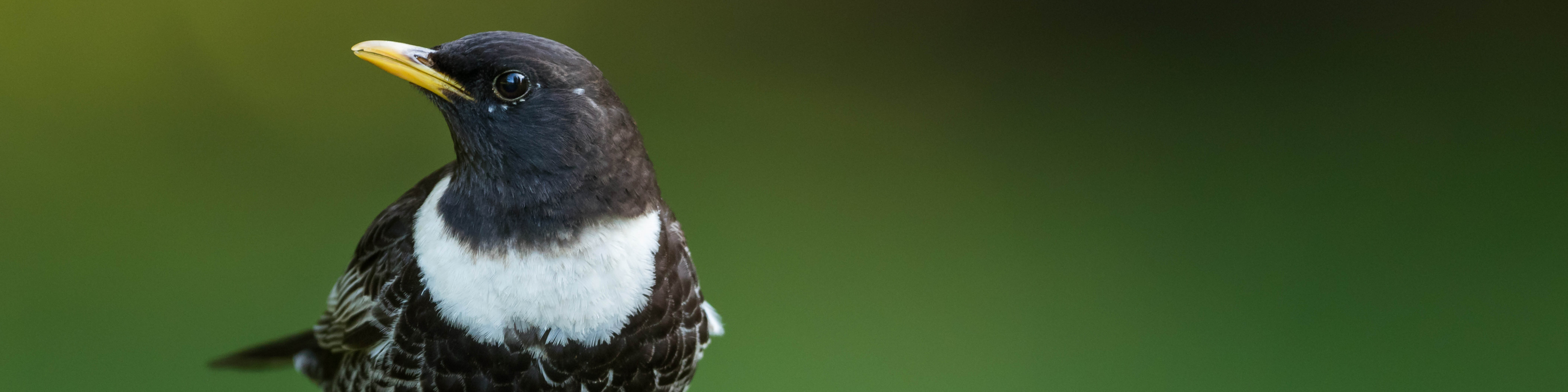
In Ireland, most upland birds depend on the retention of blanket bog or heath. These include several bird species of high conservation concern, such as the Whinchat, Red Grouse and European Golden Plover. In this context, the enigmatic Ring Ouzel is a rare visitor to Irish uplands, and little is known about its status and population trends. The 2021 survey in the Republic of Ireland aimed to determine its current breeding population size and range.
The survey team, led by Allan Mee, identified tetrads that had records of breeding Ring Ouzels in Ireland in the previous 20 years. Using a standard methodology, including playback of their calls and song, the survey team visited tetrads at least twice to record occupancy and evidence of breeding as well as to record habitat associations and land use.
Ring Ouzels were detected in just nine of 75 tetrads surveyed, with probable or confirmed breeding in only four and possible breeding in five tetrads, all in Donegal. Habitats at Ring Ouzel breeding sites were predominantly dry heath, blanket bog and scree. Sheep grazing (in 87% of tetrads) was the most widespread land use.
The results of the survey showed that the Ring Ouzel is at ‘imminent risk of extinction in Ireland’ after the loss of the breeding population in County Kerry within the last decade. Furthermore, the findings show that a tiny, remnant population is now confined to County Donegal, where it is likely to still be declining.
Here, only three territorial pairs were present in 2018, with at least one of which bred, falling to two pairs in 2019. By 2021, this had fallen to a ‘single pair’. ‘The conversion of heath to grass moorland appears to be an important factor driving the decline in Ireland’, the author notes.
The substantial declines recorded in these areas, combined with the lack of records indicating recent breeding elsewhere suggest that the Irish population has declined severely. These findings are set out in a paper published in Bird Study, the BTO’s scientific journal, in June 2026.
The fourth British & Irish Breeding Bird Atlas, due to commence in 2027, may be a timely opportunity to confirm the results of the current survey. However, Ireland’s position at the extreme western edge of the species’ range and its main flyway through Britain and Scandinavia, may also make it more vulnerable to decline and diminish the likelihood of recolonisation, as fewer birds migrate along the western edge of the range.
Climate change effects such as drier summers, may also be impacting the accessibility and availability of invertebrate prey. The authors suggest that ‘urgent conservation actions are needed to halt further decline to extinction, especially in the few remaining breeding areas’ such as Glenveagh National Park in Donegal.
Ring Ouzel conservation remains the most urgent priority if the species is not to be lost as a breeder in Ireland within the next decade. Such management could be implemented via a bespoke results-based Agri-Environment Scheme (AES) focused on rapidly reducing grazing pressure, covering all current Ring Ouzel breeding areas to halt current declines.
Reference: Allan Mee, Robert Vaughan, Daniel Moloney, Tomasz Siekaniec, Laura Kavanagh, Paul Whitelaw & Sinéad Cummins (24 Jun 2026): Decline to near extinction of a mountain passerine: the status of the Ring Ouzel Turdus torquatus in the Republic of Ireland in 2021, Bird Study, DOI: 10.1080/00063657.2026.2686879. Link https://doi.org/10.1080/00063657.2026.2686879