

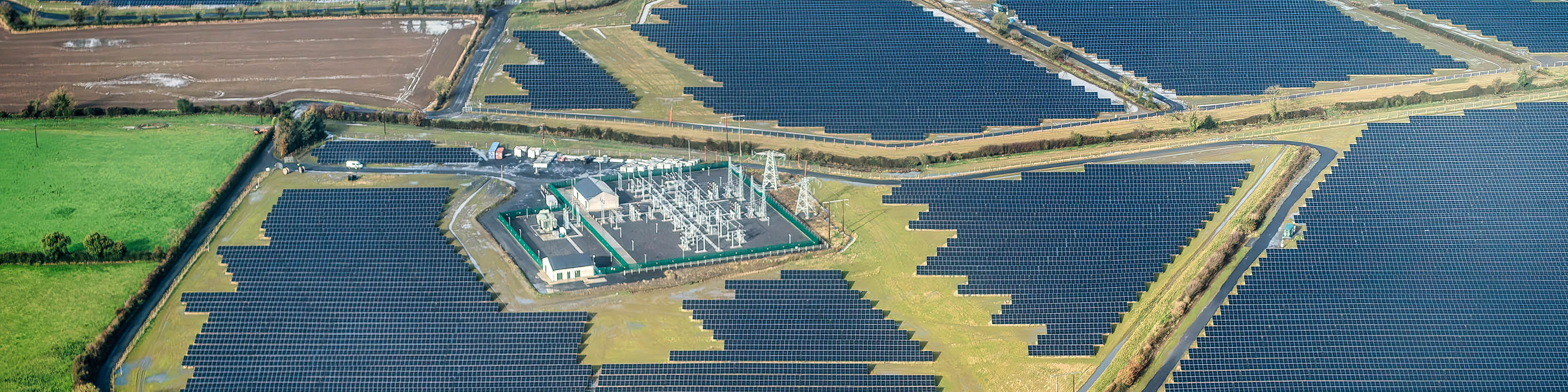
Solar planning in Ireland is changing. While recent appeal decisions point to a positive consenting environment, the requirements for bringing forward a complete application are becoming increasingly demanding. MKO’s review of solar planning decisions between August 2025 and September 2026 identified 18 utility-scale solar farm appeals granted permission by An Coimisiún Pleanála, with no refusals identified during that period. Our analysis of local authority application records found that 35% were recorded as incomplete under the RED III regime.
The past year has been a significant one for solar development in Ireland, with important changes to the planning and consenting landscape. RED III (the revised EU Renewable Energy Directive) has introduced statutory timelines intended to accelerate renewable-energy consenting, while expectations around environmental information and application content have increased. The forthcoming commencement of the Planning and Development Act 2024 will also alter how solar projects and their grid connections are assembled and submitted.
Looking further ahead, the review of the Regional Spatial and Economic Strategies and the Regional Renewable Energy Strategies being prepared alongside them (expected in mid-to-late 2027) will set solar capacity allocations for individual local authorities. Local authorities will then be required to plan for the delivery of these allocations through their development plans. This has the potential to create a principle of development interpretation for solar similar to the approach for wind energy, where land is designated either ‘open to consideration’ or ‘not normally permissible’.
From MKO’s perspective, the central takeaway is that projects reaching An Coimisiún Pleanála are getting planning permission, but the level of input, assessment, survey and reporting required has become more onerous, with much of that work now heavily front-loaded.
A positive decision-making environment
An Coimisiún Pleanála’s case repository provides a useful snapshot. Based on decisions issued during the period 7th August 2025 to 25th September 2026, the Commission granted permission in 18 utility scale solar-farm appeals. We identified no solar-farm refusals by the Commission during that period1.
These figures include solar-farm appeals but exclude standalone grid infrastructure, rooftop installations and minor domestic solar proposals. They demonstrate a notably positive appeal environment. Half of the permissions (nine of the 18) were granted following refusals at local-authority level, showing the Commission’s willingness to take a different view where the planning and environmental evidence supports the development.
This does not mean that permission is automatic. Landscape, residential amenity, ecology, archaeology, drainage, glint and glare, traffic and grid-related effects can still lead to a refusal. What the figures suggest is that a well-selected site, supported by a comprehensive and coherent application, continues to have a strong planning pathway.
RED III and the completeness check
The European Union (Planning and Development) (Renewable Energy) Regulations 2025 brought the principal RED III planning provisions into effect in August 20252. The new regime introduced statutory permit-granting timelines and, importantly, a formal completeness check. The decision-making clock generally begins only once an application has been declared complete.
The practical effect is that a portion of the risk has shifted to the front of the process. Matters that might previously have been addressed through a further information request are increasingly expected to be resolved before lodgement. If an application is found incomplete, the application and fee are returned and a fresh application, public notice and public-participation process are required.
How many solar applications have failed the completeness check? MKO’s review of publicly available information on local authority planning application databases identified 100 utility-scale solar application records during the first 13 months of the RED III regime, from 7th August 2025 to 25th September 2026. Of those 100 records, 35 were expressly recorded as ‘incomplete applications’3. This represents 35% of the relevant application records reviewed. Some care is needed in interpreting this figure. It relates to application lodgements rather than unique solar projects, and a number of projects were resubmitted, sometimes more than once, before progressing through the process.
Understanding the new consenting timelines
The RED III Directive has set a 52-week maximum decision time limit on local authorities where RED planning applications are made to them, and the same principle applies to An Coimisiún Pleanála where applications are made directly to them. However, for local authorities, the normal eight-week decision period under section 34(8) has not been replaced. Instead, for renewable-energy development of 150kW or more, which captures all utility-scale solar, the Regulations add a statutory backstop: the planning authority must make its decision within 52 weeks of the completeness notice, even where further information has been sought (new section 34E). The 52 weeks is therefore an outer limit, not a target. A separate eight-week period applies to ‘relevant solar energy development’ on existing artificial surfaces such as rooftops and car parks (new section 34G). At the time of writing, the Planning and Development Act 2024 and its associated Regulations do not make provisions for consenting timelines associated with RED projects although it is anticipated that Regulations will be published.
Why early bird surveys are increasingly important
Ecological expectations for solar have also moved on. Until relatively recently, dedicated breeding- or wintering-bird surveys were commonly confined to sites with an obvious ornithological sensitivity. We are now seeing them requested much more regularly, particularly where large areas of grassland or tillage may provide feeding, roosting or nesting habitat, or where there is a potential connection with a Special Protection Area.
The implications for programme planning are significant. A requirement for seasonal survey cannot always be met in a few weeks, and missing the appropriate wintering or breeding bird window can delay lodgement by several months. An early ecological constraints review should establish not only whether a Natura Impact Statement (NIS) is required, but whether a seasonally complete evidence base will be expected.
Archaeology: investigation before application
A similar change is evident in archaeology. On large greenfield solar sites, we are seeing an increase in planning authorities or consultees seeking and, in some cases, requiring geophysical survey and, where anomalies arise, targeted test trenching before an application is treated as complete. This is not a universal statutory rule for every solar project, but it is becoming an increasingly important practical expectation. For developers, archaeology can no longer safely be treated as a post-permission condition by default. Survey licences, land access, crop cycles and the time needed to interpret results must all be built into the pre-application programme.
The grid connection is part of the project
The Ó’Gríanna principle4 remains central where the solar farm and grid connection are pursued through separate applications. In essence, the High Court found that a renewable-energy project could not be artificially divided so that the environmental effects of its grid connection escaped assessment.
Separate planning applications for a solar farm and its grid infrastructure are not necessarily prohibited. However, the environmental assessment must identify the project as a whole and assess the likely grid route and its cumulative effects to a sufficient level. A grid connection described only as a future matter for EirGrid or ESB Networks creates obvious consent and judicial-review risk.
The correct strategy is project specific. Sometimes the grid route can be incorporated into the solar application; sometimes a separate electricity-infrastructure consent is required. Either way, the two applications must be assessed as a single project. The consenting route for solar projects and their grid connections is also changing under the Planning and Development Act 2024, as set out in the next section.
How the Planning and Development Act 2024 could change solar consenting
The Planning and Development Act 2024 will add another layer of change when its development-consent provisions commence. At the time of writing, sections 85 and 115 are not yet operational, but the Department has published the majority of the supporting 2026 Regulations (in draft) in advance of commencement5.
Section 85 concerns eligibility to apply. For grid cables within public roads, an applicant will need to demonstrate an appropriate ownership or legal interest, a relevant statutory power, or written consent from a qualifying landowner, interest-holder or statutory undertaker. In practice, obtaining the necessary consent from the relevant road authority, EirGrid or ESB Networks, depending on ownership and statutory responsibility, may become a critical-path item rather than a document collected shortly before lodgement.
Section 115 is potentially more transformative. Where only part of a development falls within the Chapter 4 strategic infrastructure regime, the application for the entire development shall be made to the Commission. This may provide a clearer single consent pathway where, for example, the grid element is strategic infrastructure, but the solar farm would otherwise be standard development. Our interpretation of this element of the legislation indicates that it may still be possible to phase planning applications for renewable energy development even where one element is Chapter 4 strategic-infrastructure development (provided the Ó’Gríanna principle is complied with).
The definition of transmission infrastructure will be central to how section 115 applies to solar. Under the 2000 Act, a grid connection is strategic infrastructure only where it amounts to electricity ‘transmission’ under section 182A. As a result, a solar farm connecting at 110kV has often needed a separate application to the Commission for its substation and grid connection, while the solar farm itself, and connections at distribution voltages such as 20kV or 38kV, have remained with the local authority. The 2024 Act carries electricity transmission infrastructure development into the Chapter 4 strategic infrastructure regime. Whether a project’s grid connection falls within that definition will therefore decide whether section 115 applies and the entire development, solar farm included, may be made to the Commission.
How this works in practice will become clearer once the provisions commence. Either way, consenting strategy will need even greater focus at the earliest stages of a project.
Regional Renewable Energy Strategies: from targets to territory
The next major change for solar may arise not from development management, but from the review of the Regional Spatial and Economic Strategies and the preparation of Regional Renewable Energy Strategies (RRES) expected in mid-to-late 20276.
The revised National Planning Framework moves renewable-energy planning beyond general expressions of support. It allocates Ireland’s 8 GW solar PV target7 to 2030 between the three regions: 3,600 MW for the Eastern and Midland Region, 3,440 MW for the Southern Region and 960 MW for the Northern and Western Region. The Regional Assemblies must translate those figures into target power-capacity allocations for individual local authorities, which will then be required to plan for the delivery of their allocations through their city and county development plans.
MKO understands that the RRES methodology8 will establish the existing renewable-energy baseline and then calculate the remaining “gap to capacity allocation”. That capacity gap is then converted into a minimum land requirement and, after allowing for project attrition and delivery rates, a larger theoretical land area that must be identified.
The spatial exercise is particularly significant. Certain lands will first be removed through defined exclusion criteria. The remaining land will then be classified as having high, medium, low or no sensitivity by reference to environmental, planning and infrastructure considerations. Grid availability, solar resource, landscape sensitivity, cumulative effects, land use and socioeconomic opportunities will also inform the assessment.
Strictly speaking, the Regional Renewable Energy Strategies will not themselves zone individual sites. The methodology describes the regional mapping exercise as a decision-support tool and reserves the formal designation of suitable and unsuitable areas for the city and county development plan process. Each local authority will ultimately determine which lands are most and least suited to grid-scale renewable-energy development.
In practice, however, this is likely to produce something approaching a go/no-go spatial framework for solar. A site located within an identified lower-sensitivity or preferred area should have a materially stronger planning-policy foundation. A site outside those areas, or within an area identified as highly sensitive or unsuitable, may face a substantial policy obstacle before its project-specific merits are even considered.
Preferred-area status will not amount to planning permission in principle. Projects will still require proper assessment of ecology, archaeology, landscape, drainage, grid infrastructure and cumulative effects. Equally, land outside a preferred area may not be legally incapable of development. Much will depend on the wording ultimately adopted in individual development plans.
For developers, timing is the important point. Decisions being made now about land portfolios, grid routes and project pipelines may be tested against a much more prescriptive spatial framework within the lifetime of those projects. Once the maps and capacity allocations are adopted, changing the strategic planning context for an individual site could be considerably more difficult.
Looking ahead
The direction of travel is positive but challenging. Decision makers continue to recognise the national importance of renewable electricity, and the recent solar appeal record is strong. At the same time, RED III and the forthcoming 2024 Act, together with more extensive ecological and archaeological investigation, are making early project definition more important than ever.
The best-performing solar projects will be those that settle the site, grid route, survey programme, land consents and consenting pathway as one coordinated exercise. The opportunity is substantial, but the quality of the work completed before lodgement will increasingly determine whether the statutory clock becomes an advantage or a problem.
How MKO can help
If you are bringing a solar project forward, or reviewing a pipeline against these changes, our teams work with developers from site selection through to consent, shaping survey programmes, grid strategy and the consenting route so that applications are complete and comprehensive from the day they are lodged. Email Seán McCarthy, Project Director – Planning Renewables, at smccarthy@mkoireland.ie to arrange an early-stage review.
A note on our figures: Appeal figures are based on a review of An Coimisiún Pleanála’s online case repository and cases determined 7th August 2025 to 25th September 2026. Completeness figures are based on MKO’s review of the local authority e-planning portals for applications lodged between 7th August 2025 and 25th September 2026.
- Figures derived from a search of ACP cases conducted at https://www.pleanala.ie/en-ie/case-search ↩︎
- Available here: https://www.irishstatutebook.ie/eli/2025/si/274/made/en/print ↩︎
- MKO undertook a review of the planning lists published by all local planning authorities in the country to identify relevant planning applications. Utility scale solar is any solar project with an maximum export capacity (MEC) >5MW or a site area >2 ha or both. ↩︎
- Ó’Gríanna v An Bord Pleanála [2014] IEHC 632 ↩︎
- Available here: https://www.gov.ie/en/department-of-housing-local-government-and-heritage/publications/draft-planning-and-development-regulations/ ↩︎
- As stated here – https://southernassembly.ie/wp-content/uploads/2026/03/RSES-Issues-Paper.pdf#page=24 ↩︎
- National Planning Framework (April 2025) ↩︎
- Methodology available here- https://www.etenders.gov.ie/epps/cft/listContractDocuments.do?resourceId=8427640 ↩︎